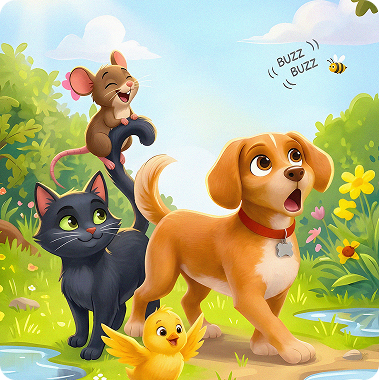
Children learn best when their senses are awake. They listen, look, repeat, laugh, and ask questions long before they understand that they are building real skills. A story with animal sounds, movement, counting, and curiosity can turn reading time into an active experience. That is why Jude’s journey to find Savannah feels so inviting for little readers.
In Savannah and Jude Play Pretend, Jude does not simply walk from one place to another. She listens. She counts. She notices sounds in the bushes, in the grass, near the flowers, and around the puddles. Each sound becomes a small mystery. “Meow,” “squeak,” “chirp,” “buzz,” and “ribbit” give children something fun to repeat, but they also help strengthen early listening and language skills.
Animal sounds are especially useful for young children because they are playful and memorable. A child who may not yet feel confident with longer words can still join the story by saying “meow” or “buzz.” This creates participation, and participation builds confidence. When a child joins in, the story becomes something they are doing, not only something they are hearing.
Counting also plays an important part in Jude’s adventure. As Jude and her friends count their steps, children are gently encouraged to count along. The numbers are not presented as a formal lesson. They appear inside the movement of the story, which makes them feel natural. A child can tap fingers, clap hands, or step across the room while counting with Jude. This helps connect numbers with rhythm, memory, and action.
Curiosity ties everything together. Again and again, the animals hear a sound and wonder what it could be. That repeated question creates a pattern young readers can recognize. Patterns are helpful in children’s books because they give little ones a sense of comfort and prediction. After hearing the structure once or twice, children begin to anticipate what may happen next. They may guess the animal before it appears, which makes the reading experience even more engaging.
The story also introduces children to the natural world in a friendly way. A black cat, tiny mouse, yellow chick, bee, and green frog each bring something different to the journey. Along the way, children encounter rain, a rainbow, puddles, flowers, and sunshine. These details invite conversation. A grown-up can ask, “What sound does a frog make?” “What color is the chick?” or “Can you find the rainbow?” These small questions turn the book into a gentle learning tool.
What makes this type of learning so effective is that it never feels heavy. The child is following Jude because they want to know what happens next. They are counting because the characters are counting. They are repeating sounds because it feels fun. They are learning because the story welcomes them in.
Jude’s adventure shows that early learning does not have to be separate from joy. It can live inside a walk through the garden, a funny sound near a flower, a splash in a puddle, or a happy group of friends searching for someone special. When stories make learning feel playful, children carry those lessons with them long after the book is closed.